For thousands of years, gold has symbolized wealth, royalty, and power. Ancient civilizations stored it in temples, monarchs wore it as crowns, and modern economies still rely on it as a safe-haven asset. But in the 21st century, scientists discovered something extraordinary — when gold is shrunk to an incredibly tiny scale, it stops behaving like ordinary metal and begins acting like a futuristic technology.
This microscopic form of gold is known as nano gold or gold nanoparticles (AuNPs). These particles are so small that they are invisible to the human eye, yet powerful enough to revolutionize industries ranging from cancer treatment to agriculture and electronics.
Today, nano gold is no longer limited to jewelry boxes or bank vaults. It is helping doctors detect diseases faster, improving crop productivity, powering advanced sensors, and even shaping the future of smart technology. Scientists around the world believe that these tiny particles may become one of the most valuable scientific tools of the modern era.
What is Nano Gold?
Nano gold consists of engineered gold particles measuring between 1 and 100 nanometers (nm) in size.
To understand how small that is, imagine this comparison:
- A single sheet of paper is around 100,000 nanometers thick.
- A human hair is roughly 80,000–100,000 nanometers wide.
- Gold nanoparticles are thousands of times smaller than a strand of hair.
At this nanoscale, gold behaves completely differently from the shiny yellow metal we normally recognize. Instead of reflecting light like jewelry, nano gold interacts with light, chemicals, and living cells in unique ways because of its massive surface-area-to-volume ratio.
When bulk gold is broken into nanoparticles, the number of atoms exposed on the surface dramatically increases. This makes nano gold far more chemically active and scientifically useful than solid gold bars.
Scientists describe this transformation as a “scientific metamorphosis,” where a luxury metal becomes a multifunctional technological material.
Why Nano Gold Changes Colour

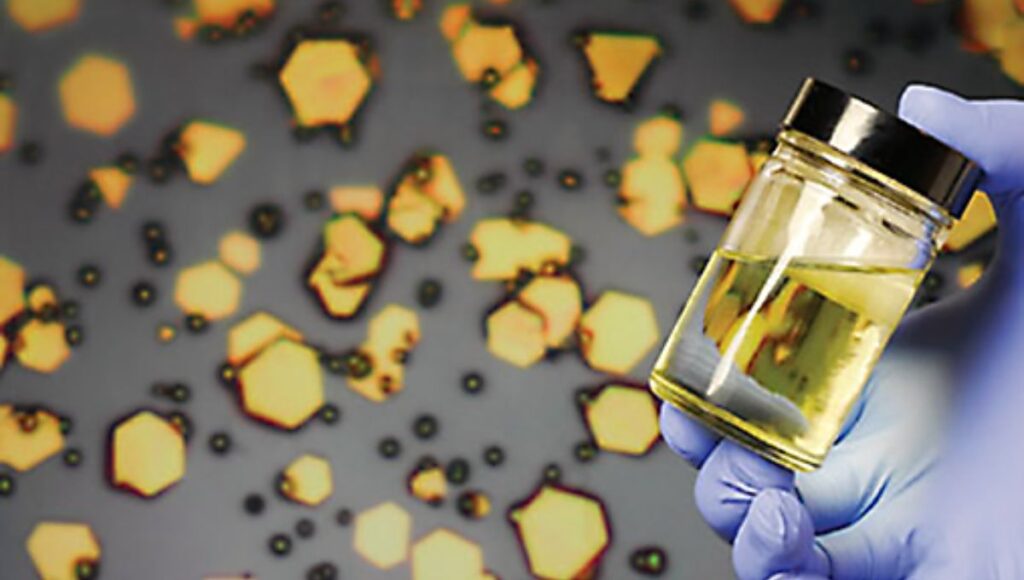
One of the most fascinating things about nano gold is that it often does not look golden at all.
Depending on its size and structure, gold nanoparticles can appear:
- Ruby red
- Purple
- Blue
- Pink
- Even nearly invisible
This colour-changing ability happens because of a scientific phenomenon called Localized Surface Plasmon Resonance (LSPR).
When light strikes a gold nanoparticle, the free electrons on its surface begin vibrating in synchronization with specific light wavelengths. These vibrations determine which colours are absorbed and which are reflected.
Colour Variations by Size
Small Nanoparticles (Around 20 nm)
These particles absorb blue and green wavelengths while reflecting red light, giving the solution a deep ruby-red appearance.
Medium-Sized Nanoparticles (50–80 nm)
As the particle grows larger, its light absorption shifts, causing the liquid to appear purple or blue.
Gold Nanorods
Special rod-shaped nanoparticles absorb near-infrared light, which is invisible to humans but extremely valuable in medical imaging and thermal therapies.
This unusual optical behavior is one of the reasons nano gold is widely used in diagnostics, biosensors, and imaging systems.
How Scientists Create Gold Nanoparticles
Producing nano gold requires advanced engineering at the atomic level. According to scientific journals such as the Journal of Nanobiotechnology, researchers primarily use two major synthesis methods.
1. Chemical Reduction Method
This is the most common “bottom-up” technique for creating gold nanoparticles.
Scientists begin with a gold salt such as hydrogen tetrachloroaurate. Then they add a reducing agent like sodium citrate.
The reducing chemical forces gold ions to combine into tiny clusters, forming stable nanoparticles suspended inside liquid.
This method allows scientists to carefully control:
- Particle size
- Shape
- Stability
- Optical properties
By adjusting the chemical ratios, researchers can produce spherical particles, nanorods, nanostars, and other advanced nano structures.
2. Green Synthesis Method
Modern researchers are increasingly shifting toward eco-friendly production techniques.
Instead of harsh chemicals, green synthesis uses natural substances such as:
- Green tea extract
- Neem leaves
- Plant enzymes
- Fungi
- Bacteria
These biological materials naturally reduce gold ions into nanoparticles while minimizing toxic waste and environmental damage.
Green synthesis is considered safer, cheaper, and more sustainable, especially for medical and agricultural applications.
Extraordinary Properties of Nano Gold
Nano gold possesses several remarkable properties that make it useful across multiple industries.
1. Biocompatibility
Gold is chemically stable and inert, meaning it does not easily corrode or react aggressively inside the human body.
Because of this, gold nanoparticles are considered highly biocompatible. They can safely interact with tissues, blood, proteins, and cells without causing major immune reactions.
This property makes nano gold ideal for:
- Drug delivery
- Cancer therapy
- Medical imaging
- Biosensors
2. Surface Functionalization
Scientists often describe gold nanoparticles as “microscopic Velcro.”
Their surfaces can easily bind with:
- DNA strands
- Proteins
- Antibodies
- Medicines
- Biomolecules
This process, called functionalization, allows researchers to customize nanoparticles for highly specific medical or industrial tasks.
For example:
A gold nanoparticle can be programmed to carry chemotherapy drugs directly to cancer cells while avoiding healthy tissues.
3. Thermal Efficiency
Gold nanoparticles can absorb light and instantly convert it into heat.
This property is extremely valuable in photothermal cancer therapy, where doctors use lasers to heat nanoparticles attached to tumor cells and destroy the cancer without invasive surgery.
4. Exceptional Stability
Unlike many metals, gold does not oxidize or rust.
This gives nano gold-based sensors and diagnostic devices a long shelf life and reliable performance over time.
Nano Gold in Medicine: A Revolution in Healthcare
The medical field is where nano gold is making some of its biggest breakthroughs.
Scientists believe gold nanoparticles could transform how diseases are diagnosed, monitored, and treated.
Nano Gold for Cancer Therapy
Cancer treatment traditionally damages both cancerous and healthy cells, causing severe side effects.
Nano gold offers a more precise alternative.
Targeted Photothermal Therapy
Gold nanoparticles are coated with antibodies designed to recognize tumor cells.
Once the particles attach themselves to the tumor, doctors expose the area to near-infrared light.
The nanoparticles rapidly heat up and destroy cancer cells while leaving surrounding healthy tissue mostly unharmed.
This method is being studied for treating:
- Breast cancer
- Skin cancer
- Prostate cancer
- Brain tumors
Researchers believe this technique may significantly reduce chemotherapy side effects in the future.
Targeted Drug Delivery
Gold nanoparticles can act as miniature delivery vehicles for medicines.
Instead of flooding the entire body with drugs, nano gold transports medication directly to the diseased area.
Benefits include:
- Lower toxicity
- Reduced side effects
- Higher treatment accuracy
- Better drug absorption
This targeted approach is considered one of the most promising future directions in personalized medicine.
Rapid Diagnostics and Disease Detection
Millions of people unknowingly use gold nanoparticles every day.
The red line seen in:
- Pregnancy tests
- COVID-19 antigen kits
- Rapid infection tests
is often created using billions of gold nanoparticles.
When specific hormones or viral proteins are detected, the nanoparticles cluster together, producing the visible coloured line.
Gold nanoparticles improve these tests because they are:
- Highly sensitive
- Fast-reacting
- Stable
- Easy to manufacture
Scientists are now developing nano gold-based sensors capable of detecting diseases like cancer and Alzheimer’s at extremely early stages.
Nano Gold in Agriculture
Agriculture is another surprising field benefiting from nano gold research.
Studies suggest that ultra-low concentrations of nano gold can function as plant biostimulants.
Nano Gold Fertilizers and Micronutrients
Researchers found that nano gold may help:
- Enhance photosynthesis
- Accelerate seed germination
- Improve nutrient absorption
- Boost enzyme activity
- Increase drought resistance
- Reduce soil salinity stress
Some studies show that gold nanoparticles stimulate important plant enzymes such as Rubisco, which plays a major role in photosynthesis.
As climate change creates harsher farming conditions, scientists are exploring nano gold as part of next-generation smart agriculture systems.
However, experts also stress the importance of regulating dosage carefully to avoid environmental risks.
Nano Gold in Technology and Electronics
Nano gold is becoming increasingly important in modern technology because of its exceptional electrical conductivity and stability.
It is now being integrated into:
- Flexible electronics
- Biosensors
- High-performance chips
- Smart wearables
- Nano-scale circuits
Because gold nanoparticles can manipulate light so effectively, they are also useful in:
- Optical sensors
- Quantum computing research
- Advanced display technologies
Scientists believe nano gold may play a key role in future nanoelectronics and photonic computing systems.
Nano Gold in Luxury and Automotive Industries
The luxury market has also embraced nano gold technology.
Searches for terms like “nano gold car coating” and “nano gold ceramic protection” have surged online in recent years.
Some high-end automotive detailing brands use ceramic coatings infused with colloidal nano gold particles.
These coatings claim to provide:
- Enhanced gloss
- Better UV protection
- Water resistance
- Longer-lasting surface durability
While much of this remains a premium niche market, nano gold is increasingly becoming associated with futuristic luxury products.
Benefits of Nano Gold
The rise of gold nanoparticles is driven by several major advantages.
Hyper-Targeted Accuracy
Nano gold can precisely target cells, biomarkers, or chemicals at microscopic levels.
Low Biological Toxicity
Gold’s inert nature allows safer interaction with living tissues compared to many synthetic materials.
Long-Term Stability
Gold nanoparticles resist oxidation and degradation, making them highly reliable.
Multi-Industry Applications
From medicine and agriculture to electronics and cosmetics, nano gold works across numerous sectors.
Advanced Optical Properties
Its ability to interact uniquely with light makes it useful in imaging, diagnostics, and sensor technologies.
Challenges and Concerns
Despite its enormous promise, nano gold also presents challenges.
Scientists are still studying:
- Long-term environmental impact
- Human toxicity at high concentrations
- Safe disposal methods
- Large-scale manufacturing costs
Regulatory agencies worldwide are working to establish safety standards for nanoparticle use in food, medicine, and agriculture.
As nanotechnology expands, responsible development will become increasingly important.
The Future of Nano Gold
The future of nano gold appears incredibly promising.
Researchers are currently exploring its use in:
- Artificial intelligence hardware
- Smart drug systems
- Precision surgery
- Water purification
- Renewable energy
- Advanced biosensors
Some experts believe gold nanoparticles may become foundational materials in next-generation healthcare and nanoengineering.
What makes nano gold so extraordinary is that it completely redefines our understanding of a familiar material. Gold is no longer valued only for its rarity or beauty — at the nanoscale, it becomes an active scientific tool capable of solving real-world problems.
Conclusion
Gold has always fascinated humanity, but nano gold reveals an entirely new side of this ancient metal.
By shrinking gold down to microscopic dimensions, scientists unlocked properties that can transform medicine, improve agriculture, power futuristic electronics, and revolutionize diagnostics.
From detecting diseases in seconds to targeting cancer cells with laser precision, gold nanoparticles are quietly shaping the technologies of tomorrow.
The world once viewed gold mainly as a symbol of wealth. Today, nano gold is proving that its greatest value may actually lie in science, innovation, and the future of human progress.