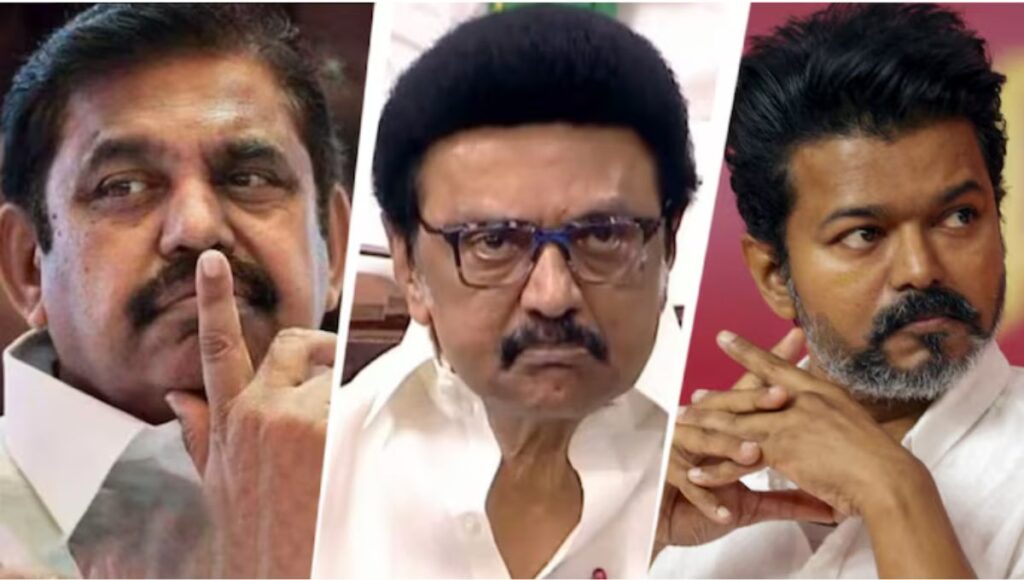
For the defeated Stalin, this verdict echoes the setbacks his father faced when he was unseated by Jayalalithaa in 1991, 2001, and 2011—though unlike him, his father never lost his own assembly seat.
Tamil Nadu politics has entered a historic new chapter. In an election that many analysts are already calling one of the most transformative in the state’s political history, actor-turned-politician Vijay and his Tamilaga Vettri Kazhagam (TVK) have delivered a political shockwave that has disrupted decades of Dravidian dominance.
What initially appeared to be a celebrity-led political experiment has now evolved into a full-scale political revolution.
Backed by a combination of young candidates, experienced political strategists, and an energized voter base, Vijay’s TVK has surged close to the halfway mark in the Assembly and fundamentally altered Tamil Nadu’s political balance.
The scale of the disruption is difficult to overstate.
Chief Minister M.K. Stalin lost his own Kolathur constituency to TVK candidate A.S. Babu, a former DMK leader. Deputy Chief Minister Udhayanidhi Stalin managed only a narrow survival in Chepauk. Across the state, unknown first-time TVK candidates challenged—and in many cases defeated—powerful veterans from both the DMK and AIADMK.
For the DMK, the verdict represents a major political humiliation.
For the AIADMK, it signals an uncertain future.
And for Vijay, it marks the beginning of a political era that could permanently redefine Tamil Nadu politics.
The Rise Of Vijay’s Political Movement
Tamil Nadu has a long history of film stars entering politics, but Vijay’s rise has unfolded differently from many earlier celebrity political experiments.
Unlike actors who relied solely on charisma or symbolic campaigns, Vijay gradually built a structured political narrative centered on change, youth participation, anti-establishment sentiment, and governance reform.
His Tamilaga Vettri Kazhagam emerged at a moment when many voters—especially younger generations—appeared increasingly frustrated with traditional political structures.
For decades, Tamil Nadu politics largely revolved around two dominant forces:
- The Dravida Munnetra Kazhagam (DMK)
- The All India Anna Dravida Munnetra Kazhagam (AIADMK)
Even when smaller parties gained influence, they usually functioned as alliance partners rather than independent challengers.
Vijay’s entry disrupted that structure.
Instead of positioning the TVK as merely another regional party, he projected it as a generational movement designed to challenge the old political order itself.
This message appears to have resonated strongly with voters.
The Collapse Of DMK’s Electoral Dominance
Perhaps the biggest headline from the election was the defeat of Chief Minister M.K. Stalin in Kolathur.
The loss carries enormous symbolic weight.
Tamil Nadu chief ministers losing their own constituencies is exceptionally rare and politically damaging. Stalin’s defeat not only removed him from power but also weakened the aura of invincibility surrounding the DMK leadership.
The victory of TVK candidate A.S. Babu—a former DMK leader—made the result even more painful for the ruling party.
Meanwhile, Udhayanidhi Stalin, who has increasingly been positioned as the future face of the DMK, retained Chepauk only narrowly.
For many observers, the election exposed deeper dissatisfaction within sections of the electorate regarding:
- Dynasty politics
- Leadership concentration within one family
- Governance fatigue
- Perceived disconnect between leadership and younger voters
The DMK remains one of the most influential political movements in Tamil Nadu history, but this verdict signals that its traditional political formula may no longer guarantee dominance.
Unknown TVK Faces Defeat Political Veterans
One of the most remarkable aspects of the election was the rise of previously unknown TVK candidates.
Candidates like Ramesh in Srirangam and several others entered the election with limited statewide recognition. Yet they successfully challenged established politicians with decades of political experience.
This reflects something larger than candidate popularity.
It suggests voters were increasingly voting for the political movement itself rather than individual reputations.
In many constituencies, TVK candidates benefited from:
- Vijay’s personal popularity
- Youth-driven campaigning
- Anti-incumbency sentiment
- Desire for political change
- Strong social media mobilisation
The success of relatively inexperienced candidates also demonstrates how dramatically the political mood shifted during the election.
Traditional political calculations based on caste arithmetic, local networks, and money power appeared less effective than before.
The “Vijay Wave” Crossed Traditional Divides
One of the most significant takeaways from the election is that the so-called “Vijay wave” appears to have crossed several traditional social and political boundaries.
Historically, Tamil Nadu elections have often been shaped by combinations of:
- Caste dynamics
- Regional influence
- Dravidian ideological identity
- Welfare politics
- Community-based mobilisation
However, Vijay’s appeal seems to have transcended many of these conventional divisions.
Political analysts observed support for the TVK across:
- Urban and rural constituencies
- Different caste groups
- Younger demographics
- Male and female voters
- First-time voters
- Middle-class urban populations
This broad support base is one reason why the TVK’s rise is being viewed as potentially transformative.
Unlike parties heavily dependent on narrow social coalitions, Vijay appears to have built a more emotionally driven political movement centered around generational change and aspirational politics.
The Youth Factor Changed Everything
The strongest engine behind Vijay’s rise was undoubtedly the youth vote.
Tamil Nadu’s younger population played a decisive role in reshaping the election outcome.
For many young voters, Vijay represented:
- A break from traditional politics
- A modern political identity
- Anti-establishment energy
- Accessibility through cinema and social media
- Aspirational leadership
Importantly, Vijay’s support extended beyond fan culture.
While his film popularity created initial political visibility, the election demonstrated that large sections of young voters viewed him as more than a celebrity candidate.
The under-40 demographic became one of the defining forces behind the TVK surge.
Social media campaigns, digital outreach, youth volunteers, and decentralized grassroots mobilisation helped the party build momentum rapidly.
This shift reflects a broader generational transition taking place within Tamil Nadu politics.
A Campaign Without Traditional Political Excess?
Another striking aspect of the TVK campaign was the perception that it relied less on traditional political inducements.
Tamil Nadu elections have historically faced accusations regarding the role of money power, voter mobilization incentives, and highly expensive campaign operations.
However, many observers felt the TVK campaign appeared comparatively restrained.
Several factors contributed to this perception:
- Strong volunteer-driven mobilisation
- Fan-based organisational energy
- Social media outreach
- Smaller campaign budgets in many constituencies
- Organic crowd participation
Despite facing setbacks—including the Karur stampede controversy and campaign restrictions—the TVK still managed strong electoral performance.
This has led some political commentators to argue that the election may represent the beginning of a new campaign style in Tamil Nadu politics, where emotional connection and digital mobilisation become more important than traditional resource-heavy structures.
Personal Challenges Faced By Vijay
The election campaign was not without personal and political difficulties for Vijay.
During the campaign period, he faced:
- Political criticism from rivals
- Questions regarding administrative experience
- Intense scrutiny of his personal life
- Social media attacks
- Controversies surrounding his film Jana Nayagan
- Pressure after the Karur stampede incident
One of the most discussed aspects was the public attention surrounding reports of his personal life and alleged divorce-related speculation.
Opponents attempted to use these narratives politically through online campaigns and public criticism.
However, many observers believe these attacks may have actually strengthened sympathy among sections of voters who viewed Vijay as facing excessive targeting from political opponents.
In modern politics, public perception often matters as much as policy.
Vijay’s image as an outsider battling established political systems appears to have resonated emotionally with many voters.
Stalin’s Defeat Revives Historical Parallels
For M.K. Stalin, the election outcome carries painful historical echoes.
Political analysts have compared his defeat to several setbacks suffered by his father, M. Karunanidhi, during earlier eras of Tamil Nadu politics.
Karunanidhi faced major defeats against both:
- M.G. Ramachandran (MGR)
- J. Jayalalithaa
However, Karunanidhi himself rarely suffered personal constituency defeats of the scale now associated with Stalin.
This distinction matters politically because leadership defeats often weaken authority within party structures.
The election has therefore created serious questions regarding the future direction of the DMK.
Dynasty Politics Under Renewed Criticism
One major issue emerging from the election is the growing backlash against dynasty politics.
For decades, critics accused the DMK of excessive family-centered leadership concentration.
Under Stalin, these criticisms intensified further due to the increasing prominence of Udhayanidhi Stalin within the party structure.
The election result suggests sections of voters may now be actively resisting dynastic political structures.
For the DMK, this creates a serious strategic challenge.
The party must now decide whether to:
- Continue centralizing leadership within the Stalin family
- Expand internal leadership opportunities
- Reconnect with ideological grassroots politics
- Rebuild youth appeal
Many analysts believe the DMK’s long-term survival may depend on whether it can reinvent itself beyond family dominance.
AIADMK: Neither Defeated Nor Victorious
If Stalin emerged as the election’s biggest loser, Edappadi K. Palaniswami (EPS) occupies a far more complicated political position.
The AIADMK has not collapsed completely.
The party managed to retain parts of its rural support base and still commands a significant number of MLAs.
However, it has slipped to third place in Tamil Nadu politics.
This is historically significant.
For decades, the AIADMK alternated power with the DMK and remained one of the two central pillars of Tamil Nadu politics.
Now, Vijay’s rise threatens to permanently reduce the AIADMK into a secondary force unless it successfully reinvents itself.
What Happens To EPS Now?
Edappadi K. Palaniswami now faces one of the toughest periods in AIADMK history.
His immediate challenges include:
- Keeping the party organisation united
- Preventing defections
- Managing internal leadership tensions
- Retaining rural voter loyalty
- Responding to Vijay’s rise
The AIADMK still possesses a strong organisational structure, but the political environment has changed dramatically.
Smaller parties that once aligned strategically with the AIADMK may increasingly drift toward Vijay’s camp.
Political observers believe Tamil Nadu may now gradually move toward a new political binary:
- TVK versus DMK
If this happens, the AIADMK risks losing its traditional central role.
Vijay’s Biggest Test Begins Now
Winning elections and governing effectively are entirely different challenges.
Vijay’s electoral success has generated enormous public expectations.
Now the real test begins.
As Chief Minister, he would need to navigate:
- Bureaucratic systems
- Administrative governance
- Law enforcement structures
- Economic management
- Welfare delivery
- Coalition management
- Political stability
Tamil Nadu possesses one of India’s most politically aware electorates. Public expectations regarding governance quality are extremely high.
Cinema popularity alone cannot sustain political legitimacy indefinitely.
Vijay’s long-term success will depend on whether he can transform emotional political momentum into effective administration.
Experienced Leaders Around Vijay
One factor working in Vijay’s favour is the presence of experienced political figures around him.
Leaders such as K.A. Sengottaiyan and several former politicians joining the TVK may help provide administrative guidance and political stability.
However, this also creates another challenge.
Vijay must balance:
- Youth-driven political energy
- Experienced leadership influence
- Party discipline
- Governance credibility
Managing these competing forces will shape the future of his administration.
Can Vijay Redefine Tamil Nadu Politics?
The larger question now is whether Vijay’s victory represents a temporary wave or the beginning of a permanent political transformation.
Several factors suggest this election may indeed represent a historic turning point.
End Of Traditional Bipolar Politics
The decades-long DMK-AIADMK dominance appears weaker than ever before.
Youth-Led Political Transition
Young voters emerged as decisive political actors.
Celebrity Politics Evolving Into Structured Politics
Unlike symbolic celebrity campaigns, the TVK developed serious electoral organisation.
Anti-Establishment Sentiment
Voters increasingly appeared willing to punish established political structures.
Cross-Social Appeal
The TVK’s support base extended beyond narrow demographic boundaries.
Taken together, these developments indicate a potentially major restructuring of Tamil Nadu politics.
The Beginning Of A New Political Era?
Tamil Nadu has historically experienced dramatic political transitions led by charismatic personalities—from C.N. Annadurai and MGR to Jayalalithaa and Karunanidhi.
Vijay may now be entering that historical continuum.
However, history also shows that sustaining political movements requires far more than electoral excitement.
Governance, internal party discipline, policy credibility, and long-term organisation building ultimately determine whether political revolutions survive.
For now, though, one reality is undeniable:
Tamil Nadu politics has changed.
The old political certainties no longer look secure.
The DMK faces existential questions.
The AIADMK faces identity challenges.
And Vijay—once viewed primarily as a film superstar—now stands at the center of a political movement capable of reshaping the future of one of India’s most politically influential states.
Whether this moment becomes a lasting political transformation or simply a dramatic electoral wave will depend entirely on what happens next.