Deserts are among the harshest and most fascinating environments on Earth. These vast dry regions are known for their extreme temperatures, minimal rainfall, powerful winds, and difficult living conditions. While many people imagine deserts as endless stretches of sand under scorching sunlight, deserts actually vary greatly in geography, climate, and biodiversity.
Some deserts are freezing cold, while others experience some of the highest temperatures ever recorded on the planet. Despite their harsh conditions, deserts continue to attract scientists, explorers, photographers, and researchers because they provide valuable insights into climate systems, geology, survival, and the natural limits of life on Earth.
Among all deserts, one place stands out for its extraordinary heat and unforgiving environment — the Lut Desert, also known as Dasht-e Lut. Located in southeastern Iran, this desert holds the record for some of the hottest land surface temperatures ever recorded on Earth.
Satellite observations have measured surface temperatures reaching approximately 70.7°C (159°F), making the Lut Desert one of the hottest known places on the planet.
Which Is the Hottest Desert in the World?
The Lut Desert is widely considered the hottest desert in the world.
Also called Dasht-e Lut, the desert lies in southeastern Iran and covers a massive area of barren terrain, rocky plains, sand dunes, and volcanic formations.
What makes the Lut Desert extraordinary is its:
- Extremely high land surface temperatures
- Dry climate
- Unique volcanic terrain
- Minimal rainfall
- Harsh environmental conditions
Scientists studying satellite data discovered that some regions of the Lut Desert repeatedly recorded the highest surface temperatures on Earth over multiple years.
The hottest region inside the desert is known as Gandom Beryan, an area covered with dark volcanic rocks that absorb and trap massive amounts of solar heat.
Where Is the Lut Desert Located?

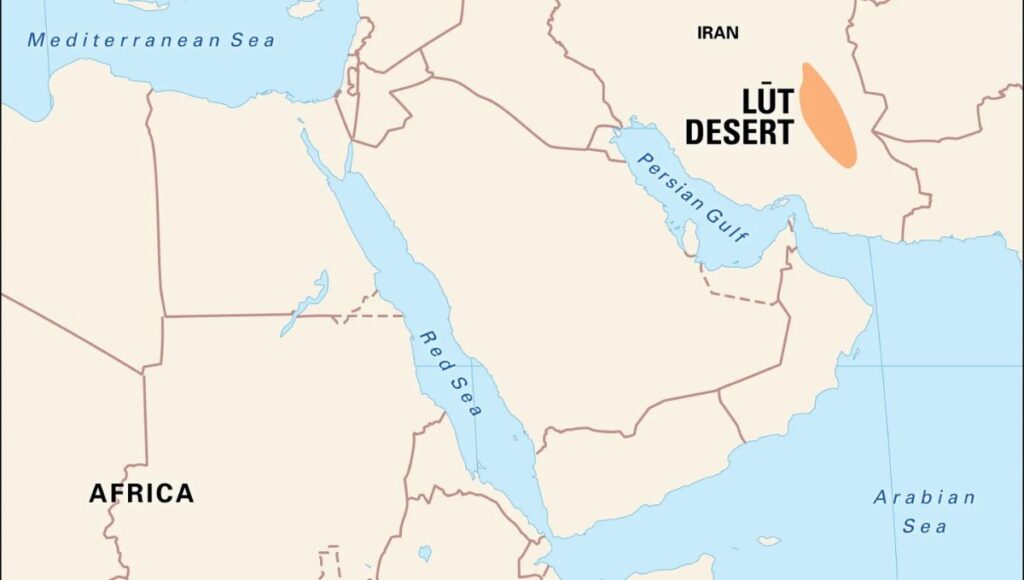
The Lut Desert is located in southeastern Iran, primarily spanning parts of:
- Kerman Province
- Sistan and Baluchestan Province
- South Khorasan Province
The desert stretches across thousands of square kilometres and forms one of the largest desert regions in Iran.
Geographically, it lies in a region surrounded by mountains and dry basins, which contribute to its extremely hot and arid conditions.
The desert’s remote location and severe climate make it one of the least hospitable places for human settlement.
Why Is the Lut Desert So Hot?
Several natural factors combine to create the extreme heat conditions in the Lut Desert.
1. Dark Volcanic Rocks Absorb Heat
One of the main reasons behind the desert’s record-breaking temperatures is the presence of black volcanic rocks in the Gandom Beryan region.
Dark surfaces absorb much more sunlight and heat than lighter surfaces. These volcanic formations trap solar radiation throughout the day, causing the ground temperature to rise dramatically.
This effect is similar to how black asphalt roads become extremely hot under sunlight.
2. Minimal Vegetation
The Lut Desert contains very little plant life.
Vegetation usually helps cool environments through shade and moisture release. Since the desert lacks significant plant cover, heat remains trapped on the surface.
3. Dry Air and Clear Skies
The desert experiences:
- Extremely low humidity
- Very little cloud cover
- Intense sunlight
Without clouds to block solar radiation, the ground receives direct sunlight for long hours every day.
4. Mountain Barriers Trap Dry Air
Surrounding mountain ranges create a rain-shadow effect.
Moist air struggles to enter the region, resulting in:
- Extremely low rainfall
- Dry atmospheric conditions
- Intense heat retention
These geographic conditions make the desert exceptionally arid.
Record-Breaking Temperatures in the Lut Desert
The Lut Desert became internationally famous after satellite studies identified it as one of the hottest places on Earth.
NASA satellite measurements recorded land surface temperatures approaching:
- 70.7°C (159°F)
These readings refer to surface temperature, not air temperature.
Difference Between Surface and Air Temperature
- Surface temperature measures how hot the ground becomes
- Air temperature measures the temperature of the atmosphere above the ground
Because the desert surface absorbs huge amounts of heat, the ground itself becomes extremely hot.
Even though air temperatures may be lower than the surface readings, the Lut Desert remains one of the hottest environments ever scientifically recorded.
What Is Gandom Beryan?
Gandom Beryan is one of the most famous regions inside the Lut Desert.
The name roughly translates to “toasted wheat,” inspired by local stories describing the area’s intense heat.
This region is known for:
- Black volcanic lava formations
- Extremely high surface temperatures
- Rocky terrain
- Minimal signs of life
Scientists consider Gandom Beryan one of Earth’s most powerful natural heat traps.
The dark lava fields absorb sunlight efficiently, allowing the surface to reach extraordinary temperatures.
One of the Driest Places on Earth
The Lut Desert is not only extremely hot but also incredibly dry.
Some regions receive:
- Almost no rainfall
- Years without measurable precipitation
The lack of moisture makes survival extremely difficult for plants, animals, and humans.
Unlike tropical climates where humidity increases discomfort, the Lut Desert’s dry atmosphere intensifies evaporation and dehydration.
Because of this, the environment is considered one of the harshest on Earth.
Unique Landforms of the Lut Desert
The desert is famous for its dramatic and unusual geological features.
1. Yardangs
The Lut Desert contains spectacular wind-carved ridges called yardangs.
These formations were shaped over thousands of years by:
- Wind erosion
- Sand movement
- Harsh desert conditions
Some yardangs stretch for kilometres and resemble giant natural walls.
2. Sand Dunes
The desert contains massive sand dunes, some among the tallest in the world.
Strong winds continuously reshape these dunes over time.
3. Salt Plains
Parts of the desert contain dry salt-covered surfaces formed through evaporation.
4. Volcanic Terrain
Dark volcanic rock fields contribute significantly to the region’s extreme temperatures.
These unique landscapes make the Lut Desert visually extraordinary and scientifically important.
UNESCO World Heritage Site
In 2016, the UNESCO recognized the Lut Desert as a World Heritage Site.
The desert received this status because of:
- Its unique geological formations
- Extreme environmental conditions
- Scientific importance
- Rare desert landscapes
UNESCO described the region as one of the world’s most remarkable examples of desert landforms shaped by wind erosion.
This recognition increased global awareness about the importance of protecting extreme natural environments.
Scientific Importance of the Lut Desert
Scientists study the Lut Desert for many reasons.
Climate Research
The desert helps researchers understand:
- Heat patterns
- Climate change
- Surface temperature behaviour
- Atmospheric conditions
Planetary Studies
Some regions of the Lut Desert resemble landscapes found on Mars and other planets.
Researchers use the desert to study:
- Planetary geology
- Dry-environment survival
- Surface erosion processes
Geological Research
The area provides insights into:
- Wind erosion
- Desert formation
- Volcanic activity
- Sediment movement
The Lut Desert essentially acts as a natural laboratory for Earth science research.
Can People Live in the Lut Desert?
Human habitation in the hottest parts of the Lut Desert is extremely limited due to:
- Extreme heat
- Water scarcity
- Harsh conditions
- Lack of vegetation
However, some communities live near the desert’s edges where conditions are less severe.
Travel inside the desert requires:
- Careful planning
- Water supplies
- Proper equipment
- Experienced guides
Because of the intense climate, survival in the inner desert remains highly challenging.
Wildlife in the Lut Desert
Although the environment is hostile, some desert-adapted species survive in surrounding areas.
Animals living in arid environments often adapt through:
- Nocturnal behaviour
- Water conservation
- Burrowing underground
Some reptiles, insects, and small mammals can tolerate desert conditions better than larger animals.
However, biodiversity inside the hottest core regions remains extremely limited.
Interesting Facts About the Lut Desert
1. It Holds Some of Earth’s Highest Surface Temperatures
Satellite data recorded temperatures near 70.7°C, making it one of the hottest places ever measured.
2. Gandom Beryan Is One of the Hottest Regions on Earth
Its volcanic rocks absorb huge amounts of solar heat.
3. Rainfall Is Extremely Rare
Some areas may go years without significant rainfall.
4. It Is Visible From Space
Satellite imagery clearly captures the desert’s dramatic terrain and heat zones.
5. It Contains Massive Wind-Carved Formations
The yardangs of the Lut Desert are among the world’s most impressive desert landforms.
6. UNESCO Recognized Its Global Importance
The desert became a UNESCO World Heritage Site in 2016.
7. It Resembles Alien Landscapes
Many scientists compare parts of the desert to Martian terrain.
8. It Is One of Earth’s Most Inhospitable Places
Extreme heat and dryness make survival difficult.
How Deserts Help Scientists Understand Earth
Deserts like the Lut Desert provide valuable information about:
- Climate systems
- Weather extremes
- Geological evolution
- Environmental adaptation
Studying extreme environments helps scientists better understand:
- Global warming
- Water scarcity
- Ecosystem survival
- Planetary conditions beyond Earth
As temperatures rise globally, research into hot desert ecosystems becomes increasingly important.
Comparing the Lut Desert to Other Hot Deserts
Other famous hot deserts include:
- Sahara Desert
- Death Valley
- Arabian Desert
However, the Lut Desert stands apart because of its extreme land surface temperatures measured consistently by satellites.
While Death Valley holds famous air temperature records, the Lut Desert dominates in surface heat intensity.
Conclusion
The Lut Desert is one of the most extraordinary natural environments on Earth. Known as the hottest desert in the world, it showcases the incredible extremes that nature can create.
Its record-breaking temperatures, volcanic rock formations, dry climate, and unique landscapes have made it an important location for scientific research and global environmental studies. The desert’s Gandom Beryan region, with its intense heat and black volcanic terrain, remains one of the planet’s most extreme natural heat zones.
Despite its harshness, the Lut Desert continues to fascinate scientists, explorers, and nature enthusiasts because it reveals how Earth functions under the most severe environmental conditions imaginable.
As climate research becomes more important worldwide, places like the Lut Desert offer valuable lessons about heat, survival, adaptation, and the powerful forces that shape our planet.