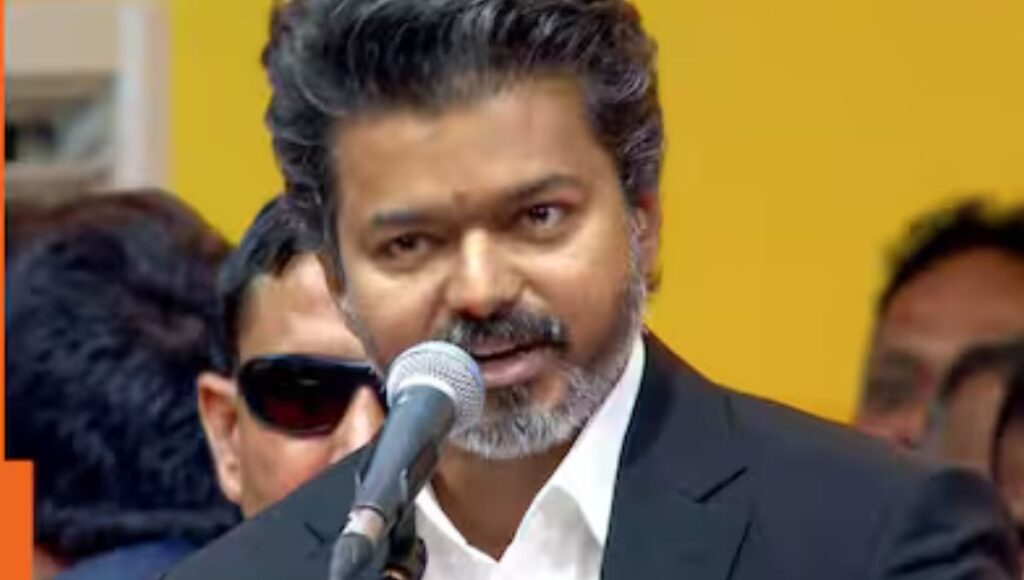
Tamil Nadu politics has entered a historic new era after actor-turned-politician Vijay secured a dramatic trust vote in the state Assembly and officially became the Chief Minister of Tamil Nadu. In a political development that few could have imagined even a few years ago, Vijay’s Tamilaga Vettri Kazhagam has broken the decades-long dominance of the Dravida Munnetra Kazhagam and the All India Anna Dravida Munnetra Kazhagam, reshaping the political landscape of the southern state.
The trust vote victory was not merely a procedural formality. It was the culmination of days of intense political negotiations, dramatic defections, ideological compromises, and strategic alliances that ultimately enabled Vijay to survive his first major test as chief minister.
The numbers in the Assembly told the story of a rapidly changing political order. Vijay received the support of 144 lawmakers, while 22 voted against him and five abstained. The result confirmed his leadership but also exposed deep cracks within the AIADMK, once one of Tamil Nadu’s most powerful political machines.
More importantly, the vote symbolized the arrival of a new political force in a state historically dominated by Dravidian giants for more than six decades.
The Rise Of Vijay: From Cinema Superstar To Chief Minister
For years, speculation surrounded whether Vijay would eventually enter politics. As one of Tamil cinema’s biggest stars, often referred to by fans as “Thalapathy,” he commanded enormous popularity across the state. His films regularly carried social and political messages, fueling expectations that he might someday convert cinematic influence into electoral success.
That transformation became reality with the launch of Tamilaga Vettri Kazhagam.
Initially, many political observers dismissed the party as another celebrity-driven experiment that would struggle against the entrenched organizational strength of the DMK and AIADMK. Tamil Nadu has seen film stars successfully enter politics before, but sustaining long-term political momentum has always been a far more difficult challenge.
However, Vijay’s campaign tapped into widespread public frustration with traditional political structures. His message of change, youth-driven governance, anti-corruption measures, and welfare-focused development resonated strongly with urban voters, first-time voters, and sections of the rural electorate seeking an alternative to the existing political binary.
The result was extraordinary.
TVK won 108 out of 234 seats in the Assembly election, an astonishing performance for a relatively new party contesting against deeply rooted regional powers. Although the party fell short of the majority mark by 10 seats, it emerged as the single largest political force in the state.
The verdict sent shockwaves across Indian politics.
For the first time in 62 years, Tamil Nadu witnessed a credible disruption to the DMK-AIADMK duopoly that had defined state politics for generations.
Why The Trust Vote Became Necessary
Despite TVK’s historic performance, Vijay still faced uncertainty after the election results because the party lacked an outright majority in the Assembly.
To remain in power, he needed support from smaller parties and independent lawmakers. The days following the election quickly turned into a high-stakes political negotiation involving alliance talks, ideological bargaining, and strategic maneuvering.
Eventually, TVK secured support from several parties, including the Indian National Congress, Left parties, the Viduthalai Chiruthaigal Katchi, and the Indian Union Muslim League.
These alliances provided Vijay with the numbers needed to prove his majority on the Assembly floor.
Speaking after the trust vote victory, Vijay declared:
“The whistle has changed history.”
Referring to TVK’s election symbol, the statement reflected the emotional significance of the moment for the party and its supporters.
Vijay also described his administration as a “minority government that will protect the rights of minorities,” signaling an inclusive political approach designed to reassure alliance partners and minority communities.
The Mathematics Behind The Victory
The Assembly arithmetic behind Vijay’s survival was remarkably delicate.
Although TVK officially won 108 seats, the effective strength of the party during the trust vote was slightly reduced due to technical and procedural factors.
One MLA became Speaker, effectively losing voting rights in the confidence motion. Vijay himself resigned from one of the two constituencies he had contested and won. Another seat remained under legal dispute following a razor-thin one-vote victory in Tiruppattur.
Despite these complications, all 105 eligible TVK MLAs voted in support of Vijay.
External allies added another 13 votes:
- Congress contributed five MLAs
- Left parties extended support
- VCK backed the government
- IUML joined the alliance
- One MLA from the Amma Makkal Munnetra Kazhagam also voted in favor
Together, the coalition reached the critical majority figure.
However, the biggest surprise came from within the AIADMK.
AIADMK Rebellion Changes The Political Equation
The most dramatic development during the trust vote was the rebellion inside the AIADMK.
Officially, party leader Edappadi K Palaniswami instructed all AIADMK MLAs to vote against Vijay. But a major section of the party openly defied him.
Twenty-four AIADMK MLAs voted in support of Vijay, while another abstained despite being considered sympathetic to TVK.
This rebellion exposed a deep leadership crisis within the AIADMK and highlighted growing dissatisfaction with EPS’s leadership.
The split did not emerge overnight.
For weeks, tensions had been building inside the party. A faction led by senior leaders including CV Shanmugam reportedly pushed for strategic cooperation with TVK, arguing that opposing Vijay could further marginalize the AIADMK politically.
Several MLAs believed the party needed to reinvent itself rather than continue losing elections while maintaining rigid opposition politics.
Their concerns were amplified by the AIADMK’s recent electoral struggles:
- Defeat in the 2019 Lok Sabha election
- Loss in the 2021 Tamil Nadu Assembly election
- Poor performance in the 2024 parliamentary election
- Another major setback in the 2026 Assembly polls
For many within the party, supporting Vijay appeared to be both a survival strategy and an opportunity to remain politically relevant.
The Crisis Facing AIADMK
The AIADMK’s internal conflict reflects a larger existential crisis.
Once led by the legendary J Jayalalithaa, the party dominated Tamil Nadu politics for years through strong welfare politics, charismatic leadership, and disciplined organization.
However, since Jayalalithaa’s death in 2016, the AIADMK has struggled to maintain unity and direction.
Factional battles, leadership disputes, and repeated electoral defeats have steadily weakened the party’s influence. Critics inside the organization accuse the current leadership of prioritizing internal power consolidation over rebuilding grassroots support.
The rebellion during Vijay’s trust vote may therefore represent more than a temporary disagreement. It could mark the beginning of a full-scale restructuring of opposition politics in Tamil Nadu.
If more AIADMK lawmakers shift toward cooperation with TVK, the traditional political alignment of the state could fundamentally change.
DMK’s Walkout And Strategic Positioning
The DMK chose a different strategy.
Instead of directly participating in the confidence vote, the party staged a walkout along with its 59 MLAs.
The decision allowed the DMK to avoid legitimizing Vijay’s government while simultaneously distancing itself from the AIADMK’s internal chaos.
For the DMK, the emergence of TVK presents a serious long-term challenge.
The party has historically positioned itself as the principal alternative to the AIADMK, benefiting from decades of stable two-party competition. Vijay’s rise disrupts that equation by introducing a third pole capable of attracting young voters, urban middle-class supporters, and even sections of traditional Dravidian constituencies.
The DMK now faces the difficult task of reinventing its political messaging in response to a charismatic leader with enormous mass appeal.
Vijay’s Biggest Challenge Starts Now
Winning the trust vote may have secured Vijay’s position temporarily, but governing Tamil Nadu will be a far greater challenge.
Unlike cinema, politics offers little room for symbolic victories alone. Expectations from the public are now enormous.
Vijay must balance multiple pressures simultaneously:
- Managing a fragile coalition government
- Maintaining unity within TVK
- Delivering on campaign promises
- Handling economic and welfare demands
- Responding to opposition attacks
- Preventing instability caused by shifting alliances
His administration also faces scrutiny over whether celebrity popularity can translate into effective governance.
Supporters believe Vijay represents a generational shift capable of modernizing Tamil Nadu politics. Critics argue he lacks administrative experience and may struggle with the realities of coalition management.
The coming months will therefore determine whether TVK becomes a sustainable political force or remains dependent on Vijay’s personal charisma.
A Historic Political Shift In Tamil Nadu
Regardless of future outcomes, one fact is already undeniable: Tamil Nadu politics has changed permanently.
The trust vote victory was more than a numerical win inside the Assembly. It marked the collapse of an old political order and the rise of a new force that has captured public imagination across the state.
For decades, Tamil Nadu politics revolved around the DMK-AIADMK rivalry. That structure now faces its biggest disruption in generations.
Vijay’s success demonstrates the growing appetite among voters for alternative leadership, especially among younger demographics seeking political renewal. It also highlights how celebrity influence, when combined with strategic organization and effective campaigning, can evolve into serious electoral power.
Whether Vijay ultimately succeeds as chief minister remains uncertain. Coalition politics in India is notoriously unpredictable, and Tamil Nadu’s political environment remains highly competitive.
But for now, the “whistle” has indeed changed history.
And Tamil Nadu has entered a bold, uncertain, and fascinating new political chapter.