
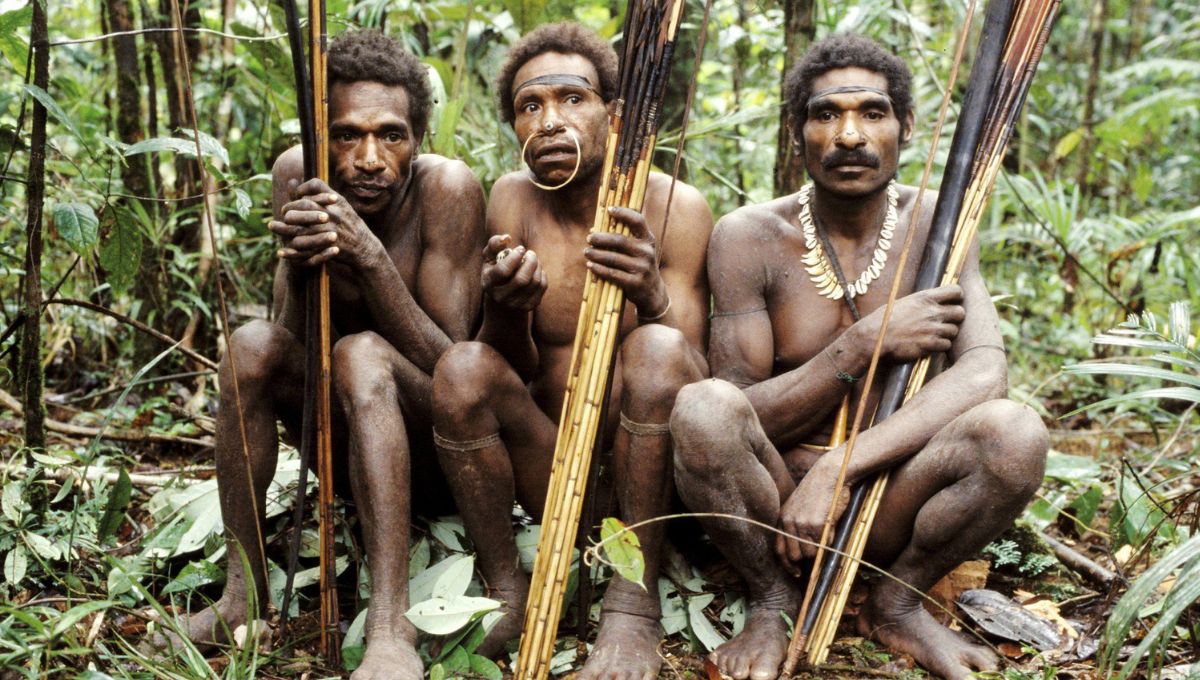
Deep within the dense tropical wilderness of Indonesia lives one of the world’s most fascinating and isolated indigenous communities—the Korowai People. Hidden in the remote rainforests of southeastern Papua, the Korowai are internationally famous for their towering treehouses, survival skills, and remarkable connection to nature.
For centuries, the Korowai lived almost entirely separated from the outside world, preserving a way of life shaped by the rainforest itself. Their culture developed in one of the most challenging and inaccessible environments on Earth—a vast region of swamps, rivers, thick jungle, and untamed wilderness.
To many outsiders, the Korowai appear almost mythical. Their homes rise dramatically above the forest floor, some reaching heights of nearly 100 feet. Their daily lives revolve around hunting, gathering, storytelling, and surviving in a landscape where nature dominates every aspect of existence.
Yet beyond the fascination and exotic imagery lies a deeper story: one of resilience, ingenuity, adaptation, and cultural survival in a rapidly modernizing world.
The Korowai are not simply “primitive people” frozen in time. They are a living society with sophisticated knowledge, social traditions, and survival skills refined over generations.
Their story offers a rare glimpse into humanity’s ancient relationship with the natural world.
A Hidden Civilization in the Rainforest
The Korowai inhabit the remote lowland forests of Papua, the Indonesian-controlled western half of the island of New Guinea.
This region is one of the most biologically diverse and geographically challenging places on Earth.
The Korowai homeland consists of:
- Dense tropical rainforest
- Vast swamps
- Winding rivers
- Thick mangroves
- Isolated jungle terrain
For much of history, the Korowai remained almost completely isolated from global civilization.
The outside world first established significant contact with them only in the late 20th century, making them one of the last indigenous communities to encounter modern society directly.
Even today, many Korowai settlements remain extremely remote and difficult to access. Reaching some villages may require days of travel by boat, canoe, and jungle trekking.
This isolation helped preserve traditional customs, languages, and survival practices that had remained largely unchanged for centuries.
The Incredible Treehouses of the Korowai
The Korowai are best known around the world for their astonishing treehouses.
These elevated homes are among the most remarkable examples of indigenous architecture anywhere on Earth.
Some treehouses are built more than 100 feet above the forest floor, towering over the surrounding jungle canopy.
Constructed entirely from natural materials such as:
- Wood
- Bamboo
- Rattan vines
- Palm leaves
- Tree bark
the structures demonstrate extraordinary engineering skill and environmental knowledge.
Building a Korowai treehouse requires:
- Careful tree selection
- Structural expertise
- Rope-making skill
- Knowledge of balance and support
- Community cooperation
The homes are usually built around sturdy banyan or wambon trees capable of supporting the structure’s immense weight.
Why Do the Korowai Live in Treehouses?
The Korowai’s elevated homes are not built simply for dramatic effect.
They serve several practical purposes essential for survival in the rainforest environment.
Protection from Flooding
Papua’s rainforest regions are prone to heavy rainfall and swamp flooding. Elevated homes help keep families safe and dry above the wet ground.
Defense Against Insects and Animals
The jungle is filled with mosquitoes, snakes, insects, and other wildlife. Living high above the forest floor reduces exposure to many of these threats.
Security and Visibility
Historically, treehouses also offered protection from rival groups or potential dangers by providing a strategic vantage point over the surrounding forest.
Cooler Temperatures
Higher elevations within the trees often provide improved airflow and cooler living conditions in the humid tropical climate.
The treehouses symbolize not only survival but also the Korowai’s remarkable ability to adapt perfectly to their environment.
Masters of Rainforest Survival
The Korowai possess an extraordinary understanding of the rainforest ecosystem.
For generations, they have survived entirely through their deep knowledge of nature.
Their daily life revolves around:
- Hunting
- Fishing
- Gathering forest products
- Sago harvesting
- Small-scale farming
Every aspect of the rainforest provides valuable resources.
The Korowai know how to identify:
- Edible plants
- Medicinal herbs
- Poisonous species
- Animal behavior
- Seasonal patterns
- Safe travel routes
This ecological knowledge has been passed down orally across generations and represents centuries of adaptation to one of the world’s harshest environments.
Sago: The Foundation of Korowai Life
One of the most important resources for the Korowai is sago, a starch extracted from certain palm trees.
Sago forms the foundation of the traditional Korowai diet.
Harvesting sago is a labor-intensive process that involves:
- Cutting down mature sago palms
- Extracting the starchy pith from inside the trunk
- Washing and processing the starch
- Cooking it into edible food
The resulting substance provides essential calories and nutrition for daily survival.
Sago is so central to Korowai life that entire social activities and routines often revolve around its collection and preparation.
Hunting in the Jungle
The Korowai are highly skilled hunters.
Using traditional bows and arrows crafted from natural materials, they hunt a variety of rainforest animals, including:
- Wild pigs
- Cassowaries
- Birds
- Tree-dwelling animals
- Small forest mammals
Hunting requires patience, stealth, and detailed knowledge of animal behavior.
The Korowai understand forest sounds, tracks, feeding habits, and movement patterns with incredible precision.
Their hunting skills demonstrate a level of environmental awareness rarely seen in industrialized societies.
Family and Community Life
Korowai society is built around close family relationships and communal cooperation.
Families often work together in activities such as:
- Building homes
- Hunting
- Food gathering
- Childcare
- Ritual ceremonies
Children learn practical survival skills from an early age by observing parents and elders.
Knowledge is passed down through:
- Oral storytelling
- Demonstration
- Ritual practice
- Shared experience
Elders hold respected positions within the community as keepers of wisdom and tradition.
Spiritual Beliefs and the Forest World
Like many indigenous rainforest cultures, the Korowai maintain spiritual beliefs deeply connected to the natural environment.
The forest is not viewed merely as land or property.
It is considered:
- A provider of life
- A spiritual realm
- A source of ancestral connection
- A place filled with unseen forces
Traditional beliefs often involve spirits connected to:
- Trees
- Rivers
- Animals
- Ancestors
- Natural events
Ceremonies and rituals may be performed to maintain harmony between humans and the spiritual world.
Storytelling also plays a major role in preserving cultural memory and spiritual identity.
Through oral traditions, the Korowai pass down myths, survival knowledge, moral lessons, and ancestral history across generations.
The First Contact With the Modern World
For much of history, the Korowai had virtually no contact with global civilization.
Anthropologists and missionaries began establishing more regular interactions only in the 1970s and 1980s.
To the outside world, the Korowai quickly became symbols of an ancient rainforest lifestyle still surviving in modern times.
Documentaries, photographers, and travelers were fascinated by:
- The towering treehouses
- Traditional hunting practices
- Remote jungle existence
- Isolation from modern society
However, outside contact also brought enormous cultural change.
Modernization and Cultural Change
As roads, missions, tourism, and government influence expanded into Papua, the Korowai faced increasing pressure to adapt.
Modern contact introduced:
- Education
- Healthcare
- Religion
- Trade goods
- Technology
- New social structures
Some Korowai communities gradually moved closer to settlements or mission stations where access to schools and medical care became easier.
Others chose to continue more traditional lifestyles deep within the forest.
The transition has not always been easy.
Modernization often creates tension between preserving ancestral identity and adapting to new realities.
Tourism and Global Fascination
The Korowai have become one of the world’s most famous indigenous rainforest communities.
Travelers and filmmakers from around the world visit Papua hoping to witness their remarkable treehouse culture firsthand.
Tourism has created opportunities for:
- Income generation
- Cultural awareness
- Economic support
But it has also raised important concerns.
Some critics argue that outsiders sometimes romanticize or sensationalize the Korowai as “lost tribes” rather than understanding them as complex modern communities.
Others worry about:
- Cultural exploitation
- Loss of privacy
- Outside dependency
- Environmental disruption
Responsible tourism requires respect for indigenous rights, traditions, and autonomy.
Environmental Threats to the Rainforest
One of the greatest challenges facing the Korowai today is environmental destruction.
Deforestation, logging, mining, and industrial development increasingly threaten Papua’s forests.
For the Korowai, the rainforest is not simply scenery—it is their home, food source, spiritual world, and cultural foundation.
Forest destruction threatens:
- Wildlife populations
- Traditional hunting grounds
- Food security
- Medicinal plant access
- Cultural survival
Protecting indigenous rainforest communities is therefore closely connected to protecting some of the world’s most important ecosystems.
The Importance of Indigenous Knowledge
The Korowai possess knowledge systems developed over centuries of direct interaction with nature.
Their understanding of:
- Forest ecology
- Sustainable living
- Natural medicine
- Wildlife behavior
- Environmental balance
represents valuable human knowledge often overlooked by modern industrial societies.
As environmental crises grow worldwide, many researchers increasingly recognize the importance of indigenous wisdom in understanding sustainable living and biodiversity conservation.
The Korowai remind humanity that survival does not always depend on modern technology.
Sometimes it depends on learning how to live in balance with nature.
Misconceptions About “Primitive” Cultures
The Korowai are often described as “primitive” by outsiders, but such labels can be misleading and disrespectful.
While their lifestyle differs greatly from industrialized societies, their culture demonstrates incredible sophistication in areas such as:
- Architecture
- Ecology
- Survival
- Social cooperation
- Environmental adaptation
Building a stable treehouse high above the rainforest canopy without modern machinery requires extraordinary intelligence and skill.
The Korowai are not backward people lacking civilization.
They are experts in surviving and thriving within one of Earth’s most demanding environments.
A Living Legacy of Human Adaptation
The Korowai represent one of the last surviving examples of a traditional rainforest society living closely connected to the natural world.
Their towering treehouses, hunting traditions, spiritual beliefs, and survival skills reflect humanity’s incredible adaptability.
In a world increasingly dominated by urbanization, digital technology, and industrial development, the Korowai remind us that alternative ways of living still exist.
Their culture demonstrates that human life can be organized around community, environmental knowledge, and deep respect for nature.
Guardians of the Rainforest Canopy
The Korowai stand as powerful symbols of resilience and cultural survival.
For centuries, they have thrived in one of the most isolated and challenging landscapes on Earth, building homes among the treetops and shaping a society deeply intertwined with the rainforest.
Today, they face enormous challenges from modernization, environmental destruction, and outside influence.
Yet many Korowai communities continue striving to preserve their traditions, language, and ancestral identity.
Their story is not merely about exotic treehouses or isolated jungle life.
It is about humanity’s enduring ability to adapt, survive, and create meaning in harmony with the natural world.
High above the forest floor, the Korowai continue to protect a cultural legacy unlike any other on Earth.