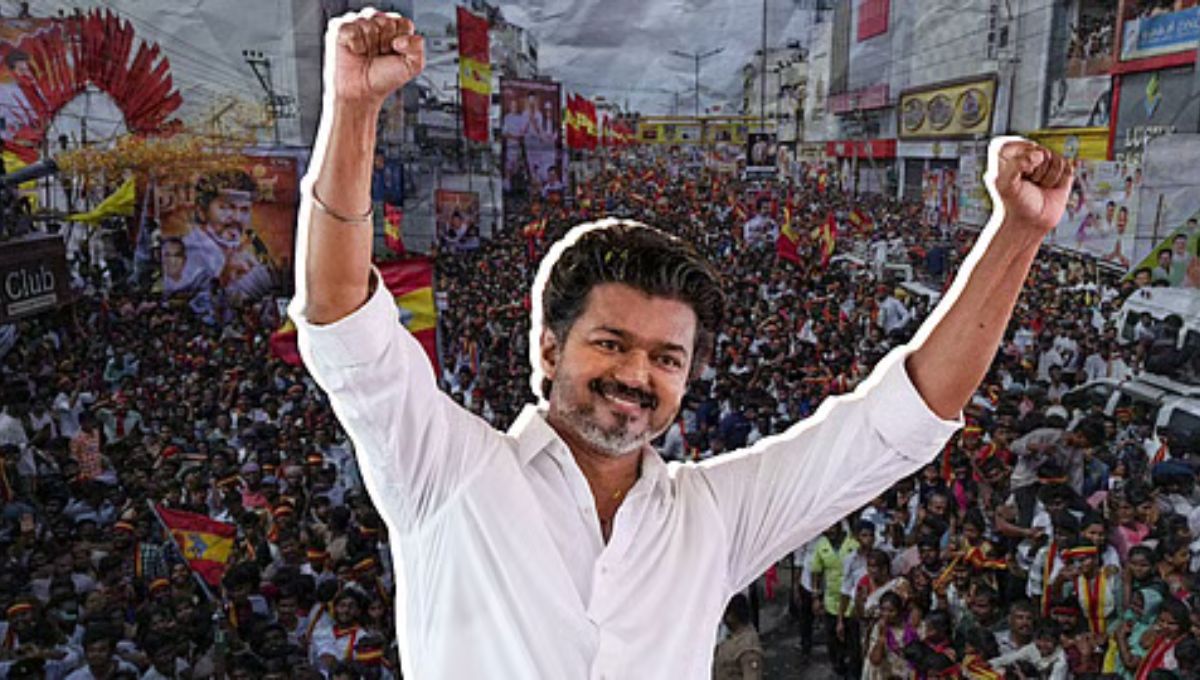
Vijay met the Governor on Wednesday, but his bid to form the next government was reportedly turned down amid doubts over whether the TVK-led alliance has the required numbers.
Tamil Nadu politics is witnessing one of its most dramatic moments in recent history as actor-turned-politician Vijay intensifies efforts to form the next government following a stunning electoral debut by his party, Tamilaga Vettri Kazhagam (TVK).
After meeting Governor R. V. Arlekar amid intense political negotiations, Vijay has signalled that his party is ready to stake claim to power and prove its majority on the Assembly floor. What began as a celebrity-led political experiment has now evolved into a full-scale battle for government formation in one of India’s most politically influential states.
The post-election developments have triggered high-voltage negotiations, speculation about shifting alliances, resort politics, and strategic calculations involving nearly every major political force in Tamil Nadu.
For decades, Tamil Nadu politics revolved almost entirely around the Dravida Munnetra Kazhagam (DMK) and the All India Anna Dravida Munnetra Kazhagam (AIADMK). Vijay’s rise through the TVK has now disrupted that long-standing political structure and created the possibility of a new power centre in the state.
However, despite the massive momentum behind Vijay’s political emergence, the road to Fort St. George remains extremely complicated.
Vijay’s Massive Electoral Breakthrough
The Tamilaga Vettri Kazhagam’s debut performance in the Assembly election shocked political observers across India.
Many analysts initially believed Vijay’s party would merely split votes or emerge as a symbolic political force. Instead, the TVK delivered one of the strongest debut performances ever witnessed in Tamil Nadu politics.
Winning 108 Assembly seats in its very first major election, the party transformed from an outsider movement into a genuine contender for state power almost overnight.
The result reflected several important political shifts:
- Growing anti-incumbency against traditional parties
- Vijay’s massive youth appeal
- Public desire for political alternatives
- Dissatisfaction with established alliance structures
- The increasing role of celebrity influence in modern politics
For millions of voters, especially younger demographics, Vijay represented not only a film superstar but also a symbol of change in a political system long dominated by familiar faces and inherited political structures.
Unlike many celebrity politicians who rely entirely on personal charisma, Vijay attempted to build a broader political narrative during the campaign. His speeches frequently focused on corruption, governance failures, youth empowerment, and the need for transparent administration.
The strategy appears to have worked far beyond expectations.
The Numbers Game: TVK Falls Just Short
Despite its extraordinary performance, the TVK still remains short of the majority mark required to independently form the government.
With 108 seats in the Assembly, Vijay’s party is currently 10 seats away from crossing the majority threshold.
This has pushed the state into a phase of aggressive coalition-building and behind-the-scenes negotiations.
Sources indicate that the Governor has sought clarity regarding whether Vijay can successfully gather enough support from alliance partners before officially inviting him to form the government.
The TVK has reportedly communicated to Raj Bhavan that it is prepared for a floor test to demonstrate majority support in the Assembly.
In parliamentary democracies, floor tests become crucial when election outcomes produce fractured mandates or coalition uncertainty. The Governor’s role in such situations becomes especially sensitive because decisions regarding invitations to form government can significantly influence political stability.
For Vijay, the immediate challenge is no longer public popularity—it is arithmetic.
Congress Offers Conditional Support
One of the most significant post-election developments has been the Congress party’s reported willingness to extend conditional support to the TVK.
However, this support comes with a major political condition: Vijay must avoid any alliance involving the Bharatiya Janata Party (BJP).
This condition reflects the Congress party’s broader national strategy of opposing BJP expansion while also attempting to remain relevant in Tamil Nadu politics.
For the Congress, supporting Vijay could offer several advantages:
- Preventing BJP influence in government formation
- Remaining politically relevant in Tamil Nadu
- Positioning itself within a potentially emerging political coalition
- Maintaining influence over a future government
At the same time, Congress leaders understand that Vijay’s growing popularity could eventually overshadow smaller alliance partners if the TVK consolidates power successfully.
Therefore, conditional support allows Congress to remain strategically involved without fully surrendering political leverage.
Crucial Role Of Regional Parties
Apart from Congress, Vijay’s hopes largely depend on securing support from influential regional parties.
The Viduthalai Chiruthaigal Katchi (VCK) and Pattali Makkal Katchi (PMK) are considered particularly important in determining whether the TVK can cross the majority mark.
Both parties possess strong regional voter bases and caste-based influence in specific areas of Tamil Nadu.
However, convincing them to support the TVK presents major political complications.
The VCK Dilemma
The Viduthalai Chiruthaigal Katchi currently belongs to the outgoing DMK alliance.
Historically, the VCK has maintained ideological positioning aligned with social justice politics and Dravidian alliance structures. Moving away from the DMK-led camp would therefore require both political justification and strategic calculations.
For the VCK, joining hands with Vijay could offer:
- Access to a potentially rising political force
- Greater bargaining power in a new coalition
- Increased ministerial influence
- Opportunity to shape a fresh political narrative
But leaving the DMK alliance also carries risks, especially if the TVK government becomes unstable.
PMK’s Strategic Position
The Pattali Makkal Katchi faces an equally complicated situation.
The PMK is currently aligned with the BJP-led bloc, meaning any support for Vijay could require distancing itself from the BJP alliance.
This becomes politically sensitive because Vijay’s campaign frequently targeted the BJP during election rallies and public speeches.
Still, the PMK is known for strategic flexibility in Tamil Nadu coalition politics. If supporting Vijay appears politically beneficial in the long term, the party could reconsider existing alignments.
Political observers believe that if both the VCK and PMK decide to back the TVK, Vijay’s coalition could comfortably cross the majority mark.
Vijay’s “Good Versus Evil” Campaign Strategy
One major reason why alliance-building has become so politically complex is Vijay’s aggressive campaign narrative during the elections.
Throughout the campaign, the TVK largely positioned itself against both the DMK and BJP, portraying the election as a battle between “good versus evil.”
This messaging strongly resonated with sections of young voters frustrated with conventional political rhetoric.
However, such aggressive positioning also created post-election complications.
Parties that were publicly criticised during the campaign may now hesitate to support the TVK without extracting political concessions.
Interestingly, while Vijay sharply attacked the DMK and BJP, the AIADMK was comparatively spared from direct criticism.
This unusual political restraint triggered widespread speculation that sections within the TVK may have deliberately avoided completely shutting the door on future cooperation with the AIADMK.
Could A TVK-AIADMK Alliance Become Reality?
Among all political possibilities currently being discussed, a potential alliance between the TVK and AIADMK remains the most fascinating—and controversial.
Although senior AIADMK leaders have publicly denied any support for Vijay, speculation continues to dominate political discussions.
Reports recently claimed that several AIADMK legislators had shifted to a resort in Puducherry amid rumours of possible support for the TVK. Such “resort politics” has become increasingly common in Indian politics during periods of government formation uncertainty.
However, top AIADMK leaders including Edappadi K. Palaniswami, C. V. Shanmugam, and K. P. Munusamy have strongly dismissed alliance rumours.
They insisted the AIADMK would not support Vijay’s government formation efforts.
Despite these denials, political analysts argue that Tamil Nadu politics has repeatedly witnessed unexpected alliances in moments of political instability.
A TVK-AIADMK partnership would dramatically reshape the state’s political future.
Together, the two parties could reportedly command more than 150 Assembly seats, creating a stable and powerful government.
Such an alliance would also represent the emergence of an entirely new anti-DMK political structure in Tamil Nadu.
Why Vijay May Hesitate About AIADMK
Even if sections within the AIADMK become open to supporting the TVK, Vijay reportedly remains cautious about such an arrangement.
The primary reason is the AIADMK’s continuing association with the BJP.
During the election campaign, Vijay heavily criticised the BJP and attempted to position the TVK as an independent alternative to both national and regional political establishments.
Aligning with the AIADMK could therefore create ideological confusion among TVK supporters.
For a new political movement, maintaining credibility becomes extremely important. Rapid ideological compromises immediately after elections can damage long-term voter trust.
Vijay’s political advisers are therefore likely weighing two competing priorities:
- Securing immediate power
- Protecting the party’s long-term political identity
Balancing these objectives is proving extremely difficult.
Governor’s Role Under Intense Scrutiny
As coalition negotiations continue, Governor R. V. Arlekar’s role has become increasingly important.
In situations involving fractured mandates, Governors often face intense scrutiny over constitutional decisions related to government formation.
The Governor must determine:
- Which party or alliance is most likely to command majority support
- Whether coalition claims appear credible
- When a floor test should be conducted
- Whether alternative options exist if no stable government emerges
The TVK has reportedly expressed readiness to prove its strength through a floor test, indicating confidence in ongoing negotiations.
However, until alliance commitments become official, uncertainty will continue dominating Tamil Nadu politics.
Possibility Of President’s Rule
If Vijay ultimately fails to secure enough support, another constitutional possibility could emerge: President’s Rule.
Under this scenario, the Governor may recommend central intervention if no party or coalition can demonstrate stable majority support.
Fresh elections could eventually follow.
However, political observers believe most parties would prefer avoiding another election so soon after a major political contest.
Fresh elections would involve:
- Massive financial costs
- Political uncertainty
- Campaign fatigue among voters
- Risk of unpredictable outcomes
Therefore, most parties are expected to continue negotiations aggressively before allowing the situation to reach constitutional breakdown.
Resort Politics Returns To Tamil Nadu
As uncertainty grows, resort politics has once again entered the spotlight.
Reports suggest that TVK legislators have been shifted to a resort in Mamallapuram near Chennai while negotiations continue.
Such moves are often aimed at preventing political poaching, internal defections, or external pressure during sensitive coalition-building phases.
Indian politics has witnessed similar resort strategies in several states over the past decade, especially during hung Assembly situations.
By isolating legislators in secure locations, party leadership attempts to maintain unity and avoid sudden political shifts.
The image of newly elected TVK legislators staying together at a resort has also added dramatic visual symbolism to Vijay’s first major political power struggle.
Can Vijay Redefine Tamil Nadu Politics?
Regardless of the final outcome, one reality has already become clear: Vijay has fundamentally altered Tamil Nadu’s political landscape.
For decades, politics in the state revolved almost exclusively around the DMK and AIADMK. Even when smaller parties gained influence, they generally functioned as alliance partners rather than independent challengers.
The TVK’s rise has disrupted this structure.
Several factors make Vijay’s emergence politically significant:
Collapse Of Traditional Bipolar Politics
The election suggests growing voter willingness to move beyond the traditional DMK-AIADMK framework.
Youth-Driven Political Mobilisation
Vijay successfully converted fan-based popularity into political energy among younger voters.
Celebrity Influence In Modern Politics
Tamil Nadu has a long history of film personalities entering politics, but Vijay’s rapid electoral success has revived debates about cinema’s continuing political power.
Demand For Political Alternatives
The TVK’s performance reflects broader public appetite for change, particularly among urban voters and first-time voters.
The Road Ahead For TVK
Even if Vijay successfully forms the government, his challenges will only begin afterward.
Coalition governments require constant negotiation, alliance management, and compromise.
As a first-time political administrator, Vijay would face enormous expectations regarding governance, economic management, welfare delivery, and political stability.
He would also need to transform the TVK from an election-focused movement into a durable political organisation capable of long-term governance.
This includes:
- Building administrative expertise
- Managing coalition partners
- Strengthening district-level party structures
- Developing policy credibility
- Balancing populism with governance realities
For now, however, the immediate battle remains focused on securing the numbers needed to form government.
A Defining Moment In Tamil Nadu Politics
Tamil Nadu now stands at a historic political crossroads.
Vijay’s rise represents more than the success of a celebrity politician—it signals potential generational change in one of India’s most politically conscious states.
Whether he ultimately becomes Chief Minister or not, the current developments have already transformed the political conversation across Tamil Nadu.
The coming days will determine whether the TVK can successfully navigate coalition arithmetic and political contradictions to form the next government.
Until then, negotiations, strategic calculations, and intense speculation will continue dominating the state’s political atmosphere.
For Vijay, the challenge is no longer winning public attention.
It is proving that a new political force can survive—and govern—in the complex realities of Tamil Nadu politics.